COMPLIANCE & ENVIRONMENTAL · ROADSIDE INSPECTION
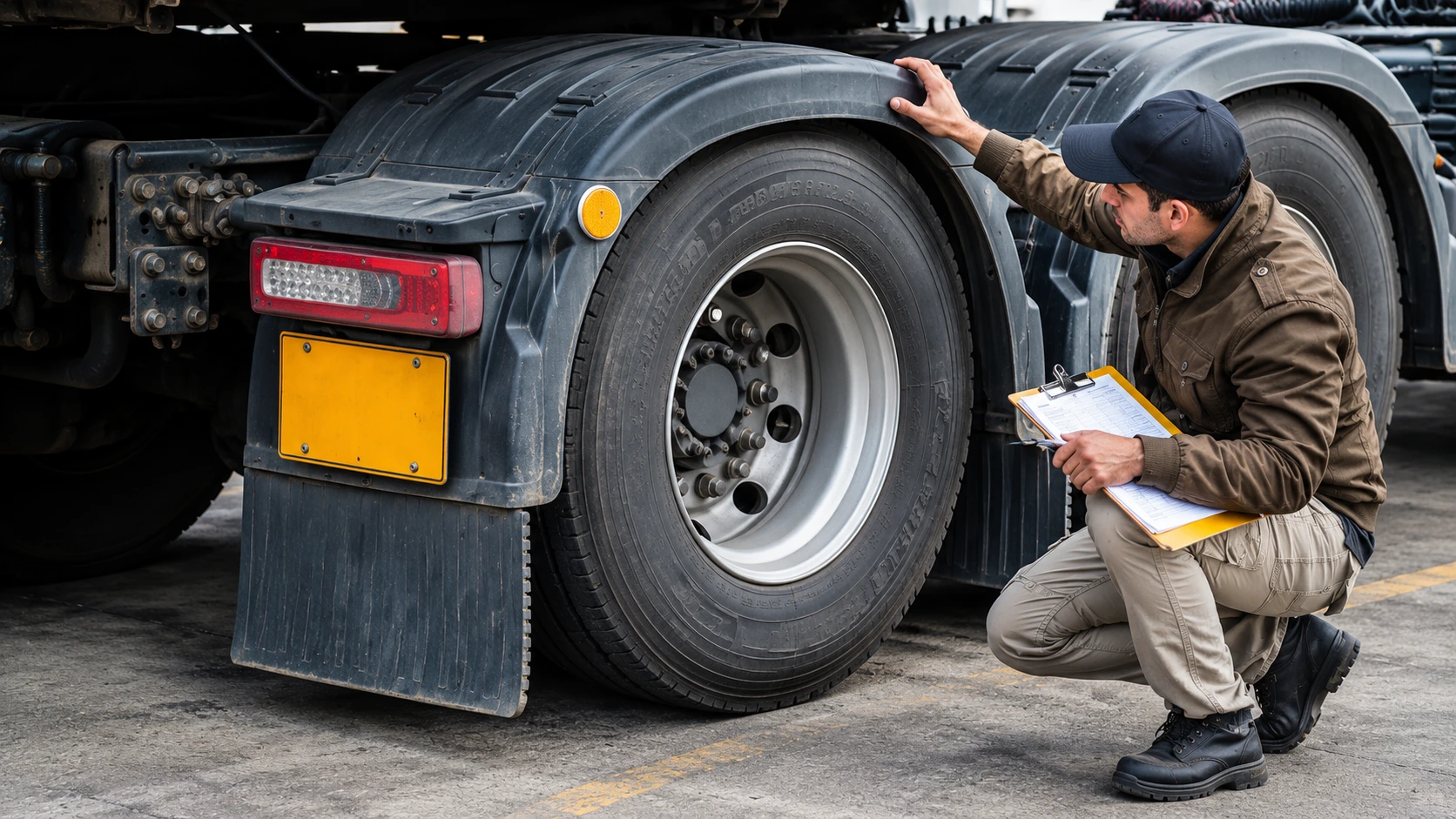
A driver pulls into the scale house on I-35 south of Fort Worth and gets the wave to the inspection lane. The tractor is three weeks past its last wash and the trailer’s conspicuity tape is grey under a film of road grime. He’s heard two things from two different fleet managers. One said a dirty truck gets you pulled in. The other said it doesn’t matter, they’re looking at brakes. Both of them are partly wrong, and the difference costs money.
QUICK ANSWER
Nothing in the Federal Motor Carrier Safety Regulations requires a commercial truck to be clean. 49 CFR Part 393 sets the equipment standards and Part 396 sets inspection and maintenance requirements, and neither mentions washing. A clean truck does not pass a DOT inspection; a maintained truck does. What cleanliness actually affects is narrow and specific: lamps and reflectors must be visible and reflective, conspicuity tape must reflect, the USDOT number and carrier name on the cab must be legible from 50 feet, hazmat placards must be readable, and fluid leaks must be findable. Grime defeats all five, and all five are inspection items. The bigger effect is upstream: a clean truck lets your driver see defects on the pre-trip under 396.11 and lets your mechanic see them at the PM under 396.3, before an inspector does. Clean trucks make defects visible. Fixing the defects is what keeps the truck on the road.
MOBILE FLEET WASHING
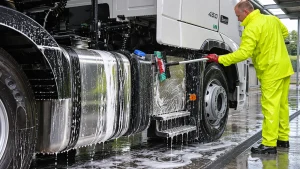
Scheduled washes on your yard during downtime, so every pre-trip and every PM starts on a truck you can actually see.
See Mobile Fleet Washing →
1. What a DOT inspection actually checks
“DOT inspection” is the shorthand. The inspection itself follows the Commercial Vehicle Safety Alliance’s North American Standard Inspection Program, which state enforcement officers apply. In Texas that’s the Department of Public Safety’s Commercial Vehicle Enforcement service, at fixed scale facilities and roadside.
There are eight inspection levels. The three a fleet manager sees most:
Level I, the full inspection. Driver credentials and hours, plus a walk-around and under-vehicle check of brakes, coupling, exhaust, frame, fuel system, lighting, securement, steering, suspension, tires, wheels, and windshield wipers. This is the one with the creeper.
Level II, walk-around. Same scope as Level I for everything the officer can see without going under the vehicle.
Level III, driver only. License, medical card, hours of service, seat belt, and the inspection report.
The standards those inspections apply come from 49 CFR Part 393, Parts and Accessories Necessary for Safe Operation, and the out-of-service criteria CVSA publishes each April. The maintenance obligations behind them come from 49 CFR Part 396.
Read through all of it looking for the word “clean” and you’ll find it nowhere as a requirement for the vehicle’s exterior. The regulations care whether equipment works and whether it’s been inspected. They do not care whether it’s washed.
That’s the honest starting point. So why does every fleet manager have a story about cleanliness and inspections? Because a handful of inspection items are things grime physically interferes with, and because the inspection you avoid is the one your own people would have caught first on a truck they could see.
2. The claim we won’t make, and why
You’ve seen it in wash company marketing: a clean truck “attracts less scrutiny,” or “improves your CSA score,” or “signals compliance to inspectors.” We’re not going to say any of that, for two reasons.
First, it isn’t in the rules. How an officer selects a vehicle for inspection involves screening systems, weigh-station protocols, carrier safety ratings through FMCSA’s Inspection Selection System, and the officer’s own judgment. None of those is published as “pull in the dirty one,” and no vendor can promise a wash changes the outcome.
Second, it gets the mechanism backwards. CSA scores come from violations recorded on inspection reports and from crashes. A wash doesn’t remove a violation. Fixing a cracked air line removes a violation. The way a clean truck relates to a CSA score is indirect: it lets the defect get found and fixed before the inspection. That’s a maintenance outcome, and the wash is a step toward it, not a substitute for it.
So the accurate claim is this, and it’s enough: a clean truck is an inspectable truck. By your driver, by your mechanic, and, when it comes to that, by the officer. What the officer finds on a maintained truck is nothing. What he finds on a neglected truck is whatever your own people couldn’t see through the dirt.
3. The five inspection items grime actually interferes with
Here is the specific, defensible list. Each is a regulation that cleanliness touches directly, with the section, and what to do about it.
| ITEM | REGULATION | WHAT GRIME DOES | WHAT TO DO ABOUT IT |
|---|---|---|---|
| Lamps | 49 CFR 393.9 (lamps must be operable) and 393.11 (required lamps and reflectors) | A lamp caked in road film is operable by the letter and invisible in practice. Officers test visibility, not just the switch. | Wash lenses on the schedule and have drivers wipe them on the pre-trip. A working lamp nobody can see is still a problem. |
| Reflectors and reflex reflectors | 49 CFR 393.11, 393.13 and 393.26 | A reflector covered in dirt doesn’t reflect. The item exists only to be seen. | Same as lamps. Rear and side reflectors on trailers are the ones that go first. |
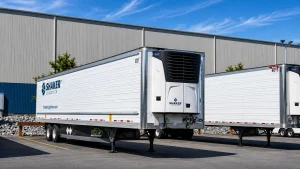
| Conspicuity tape | 49 CFR 393.11 and 393.13 (retroreflective sheeting on trailers) | The red-and-white tape on trailer sides and rear is required to retroreflect. Grey film kills it. Damaged or missing tape is a violation; dirty tape fails the purpose. | Wash trailer sides and the rear impact guard. Replace tape that’s peeling; washing won’t fix that. |
| Carrier marking: name and USDOT number | 49 CFR 390.21 (legible from 50 feet in daylight, on both sides of the power unit) | Mud on the cab doors makes the marking illegible, which is a violation of 390.21 regardless of whether the lettering is there. | Keep the cab doors clean. This is the cheapest violation on the list to avoid and one of the easiest to get. |
| Hazmat placards | 49 CFR 172.516 (placards must be clearly visible and readable) | A placard the officer can’t read from the required distance is a placarding violation. | Wash placard holders with the unit. Replace faded placards; washing restores legibility, not color. |
| Fluid leaks | 49 CFR 396.3 (systematic inspection and maintenance) and the CVSA out-of-service criteria for fuel system leaks under 393.67 | A leak is invisible on a frame that’s already wet and black. On a clean frame it’s a wet spot you can point at. | Wash the frame and undercarriage, then have the shop look. The wash doesn’t fix the leak; it reveals it. |
Six rows. Five of them are about the vehicle being seen: lamps, reflectors, tape, markings, placards. The sixth is about your mechanic being able to see the vehicle. That’s the whole relationship between washing and inspection, and it’s enough to justify a wash program without inventing anything.
FROM THE BAY — THE NUMBER ON THE DOOR
A construction fleet brought a dump truck through after a week on a site off I-20. The truck ran fine and the driver had a clean log. The cab doors were mud to the window line. You could not have read the carrier name or the USDOT number from ten feet, let alone fifty. The driver said he’d been through a scale house two days earlier and been waved on. He’d been lucky. The marking rule doesn’t care whether the lettering is there under the mud; it cares whether the officer can read it. Twenty minutes in the bay and the doors said who they belonged to again.
4. The pre-trip: 396.11 and 396.13 on a truck you can see
This is where cleanliness does its real work, and it’s a mile upstream of the scale house.
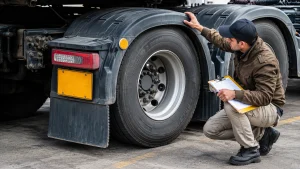
49 CFR 396.13 requires the driver to be satisfied the vehicle is in safe operating condition before driving it. 396.11 requires a written driver vehicle inspection report at the end of each day for defects found, covering brakes, steering, lighting, tires, horn, wipers, mirrors, coupling, wheels, and emergency equipment. The carrier has to repair reported defects before the vehicle runs again and certify the repair on the report.
The whole system assumes the driver can see the truck. On a unit carrying three weeks of road film, the driver’s walk-around is a formality. He can’t see a cracked lens under the grime, a chafed air line against a black frame, a loose mud flap bracket, a weeping hub seal, or a bent reflector. He checks the box because there’s nothing visible to report.
On a washed truck, the same walk-around finds those things, and the DVIR says so, and the shop fixes it before the truck leaves the yard. That is the inspection you want to pass: the one your own driver runs every morning. The one at the scale house is where you find out whether the pre-trip was real.
What to do about it: schedule washes so the pre-trip isn’t blind. For most fleets that means a regular cadence, weekly or biweekly, timed to the equipment’s downtime so the wash is done before the morning walk-around. A wash the night before a known inspection blitz is better than nothing, but it’s the schedule that makes the pre-trip work all year.
5. The PM: 396.3 and what a mechanic can see
49 CFR 396.3 requires every motor carrier to systematically inspect, repair, and maintain its vehicles, and to keep records showing it. 396.17 adds the annual inspection. The regulation doesn’t say how, beyond the minimums in Appendix A; it says the carrier has to have a system and prove it.
A mechanic working a clean frame is doing a different job than one working a dirty frame. On a clean frame he can see a hairline crack at a bracket weld, a seep at a fitting, a chafe mark on a hose, a missing fastener, a loose clamp, corrosion starting at a crossmember. On a frame under a season of road film he finds those things by feel, by luck, or later, usually when something fails.
That’s the maintenance argument for a wash program, and it’s the one that lands hardest with a maintenance manager, because finding defects early is his job. Every wash before a PM is a wash that makes the PM more thorough. It’s also why we don’t describe washing as maintenance: we wash it; your mechanic maintains it. Different jobs, same truck, and the first one makes the second one easier.
What to do about it: if the PM schedule and the wash schedule aren’t talking to each other, put them in the same calendar. A wash the week before a PM is worth more than a wash the week after.
6. How CSA actually works, and where a wash fits
FMCSA’s Compliance, Safety, Accountability program scores carriers through the Safety Measurement System on seven categories, the BASICs: Unsafe Driving, Crash Indicator, Hours-of-Service Compliance, Vehicle Maintenance, Controlled Substances and Alcohol, Hazardous Materials Compliance, and Driver Fitness. Vehicle Maintenance is the one a dirty truck relates to, and the relationship is exactly as indirect as it sounds.
Vehicle Maintenance BASIC scores come from violations recorded during roadside inspections, weighted by severity and time, and from inspections with no violations, which help. Clean inspections pull the score down. Violations push it up. Out-of-service violations push it up more.
A wash does not touch any of that directly. What it does is make the two things that do touch it more likely: the defect gets found on the pre-trip or at the PM, and the truck arrives at the inspection without it. The clean inspection that results is what helps the score. The wash was the step that let your people find the problem first.
Anyone who tells you a wash improves your CSA score is skipping a step and hoping you don’t notice. The step is the repair. The wash is what makes the repair happen on your schedule instead of the officer’s.
SIGNATURE APPROACH
Steamaway has washed commercial fleets in Dallas–Fort Worth since 1985, and the founder holds the Power Washers of North America Fleet Washing Certification. We don’t claim a wash passes an inspection, because it doesn’t. We claim that a truck washed on schedule, with every unit number on the invoice, is a truck your driver can inspect, your mechanic can maintain, and an officer can read the door of. Cleaned Right | On Time | Every Time is what makes the pre-trip real.
7. A pre-inspection wash checklist that doesn’t overpromise
Here’s what to ask for from a wash, whether in-house or a vendor, if the goal is a truck your own people can inspect. None of this is regulation. All of it serves the regulations above.
- Lamps and lenses, every one. Headlamps, marker lamps, clearance lamps, turn signals, brake lamps, license plate lamp. Cleaned, not just sprayed past.
- Reflectors and conspicuity tape. Trailer sides full length, rear, and the rear impact guard. This is where road film accumulates thickest and where it does the most harm.
- Cab doors and the carrier marking. Name and USDOT number legible from 50 feet. Check it from 50 feet.
- Placard holders on any hazmat unit, and the placards themselves.
- Frame rails, crossmembers, and the underside. Hot water, so the mechanic can see what’s leaking and what’s cracking.
- Wheels and hubs. A weeping hub seal shows as a wet streak on a clean wheel and as nothing on a dirty one.
- Windshield, mirrors, and the cab glass. Part 393.60 covers windshield condition, and the driver’s view is the point of the mirrors.
- Leave the pre-trip to the driver and the PM to the shop. A wash crew isn’t inspecting the truck. It’s making the truck inspectable.
| FLEET SITUATION | WHERE CLEANLINESS MATTERS MOST | WHAT TO DO ABOUT IT |
|---|---|---|
| Over-the-road, running I-35 and I-20 scale facilities regularly | Conspicuity tape, markings, lamps. The items an officer sees from the lane. | Regular schedule; trailer sides and rear every wash. |
| Route fleet, city streets, infrequent inspections | The pre-trip. Drivers do the same walk-around every day and stop looking. | Keep the schedule so the walk-around has something to find when there’s something there. |
| Construction and vocational, job-site mud | Carrier marking on the cab doors, placards, lamps. | A wash before any highway run after site work. Mud to the window line is a 390.21 problem. |
| Hazmat | Placards and the fuel system. | Placard legibility on every wash; frame and tank area clean enough that a leak is obvious. |
| Fleet with a Vehicle Maintenance BASIC problem | The PM. The defects are getting to the roadside before the shop finds them. | Align the wash calendar with the PM calendar so the mechanic works a clean truck. Then fix what he finds. |
FROM THE BAY — THE SEEP THE DRIVER FOUND
An LTL fleet out of Grand Prairie had a mobile wash on Sunday nights. Monday morning a driver flagged a wet spot on the inside of the right frame rail behind the cab, which he’d never noticed on that truck and which, on a dirty frame, he never would have. The DVIR went in, the shop found a fitting weeping at the air dryer, replaced it in an hour, and the truck ran its route. Nobody at a scale house ever saw it. That’s the inspection the wash helped pass: the one at 6 AM in the yard.
8. Where this leaves the two fleet managers
The one who said a dirty truck gets you pulled in was overstating what anyone can know about inspection selection, and he was selling a wash as a compliance tool it isn’t.
The one who said it doesn’t matter, they’re looking at brakes, was right about the brakes and wrong about everything the inspection also checks: whether the lamps and reflectors can be seen, whether the tape reflects, whether the door says who you are, whether the placard reads, and whether anyone on your side ever had a clear enough look at the truck to find what the officer is about to.
The practical position is between them, and it’s not complicated. Wash on a schedule tied to your downtime so the pre-trip and the PM happen on a truck your people can see. Fix what they find. The inspection at the scale house will go the way your maintenance goes. The wash just makes sure your maintenance has a fair look.
What it costs, translated: a wash is a line item on a schedule. A roadside out-of-service order is a driver, a tractor, and a load sitting on a shoulder on I-35, a tow or a mobile repair at roadside rates, a late delivery, and a violation on the record for two years. We won’t put a dollar figure on the difference; your operations manager can, and the figure will have more zeros than the wash.
Frequently Asked Questions
Does a clean truck help pass a DOT inspection?
Not by itself. No section of 49 CFR Parts 393 or 396 requires a clean truck; the rules require working, maintained, inspected equipment. Where a clean truck helps at a DOT inspection is specific: lamps, reflectors, and conspicuity tape have to be visible, the carrier marking has to be legible from 50 feet, placards have to be readable, and leaks have to be findable. Grime interferes with all of those. Maintained trucks pass; clean trucks make maintenance possible.
Is there a DOT regulation that requires trucks to be clean?
No. The Federal Motor Carrier Safety Regulations set equipment standards in Part 393 and inspection and maintenance requirements in Part 396, and neither requires the vehicle exterior to be washed. What they do require, such as visible lamps under 393.9 and 393.11 and legible carrier markings under 390.21, can be defeated by dirt, which is the only sense in which cleanliness is regulated.
Will a clean truck improve my CSA score?
Not directly. CSA’s Vehicle Maintenance BASIC is scored from violations found at roadside inspections and from clean inspections. A wash removes no violation; a repair does. A clean truck helps indirectly, by letting your driver and mechanic find and fix defects before the roadside inspection, which is what produces the clean inspection that helps the score.
Do dirty trucks get pulled over more often?
Nobody outside enforcement can say, and no wash vendor should claim it. Inspection selection involves screening systems, carrier safety data, weigh-station protocol, and officer judgment, none of which is published as a cleanliness rule. What’s certain is that once a truck is in the lane, dirty lamps, reflectors, tape, and markings are inspection items, and a dirty frame hides what the inspector will find.
Can I get a violation for an illegible USDOT number?
Yes. 49 CFR 390.21 requires the carrier’s legal name and USDOT number on both sides of the power unit, legible from 50 feet in daylight. Mud or road film that makes the marking unreadable is a violation whether or not the lettering is intact underneath. It’s one of the cheapest violations to avoid and one of the easiest to pick up after site work.
Does conspicuity tape have to be clean to pass inspection?
The regulation, 49 CFR 393.11 and 393.13, requires retroreflective sheeting on trailer sides and rear, and the out-of-service criteria address missing or damaged tape. Tape under a film of road grime doesn’t retroreflect, which defeats its purpose and is what an officer checks with a flashlight. Washing restores reflectivity; it doesn’t fix peeling or missing tape.
What does a DOT Level I inspection check on the vehicle?
Under the CVSA North American Standard, a Level I inspection covers the driver’s credentials and hours plus brakes, coupling devices, exhaust, frame, fuel system, lighting, cargo securement, steering, suspension, tires, wheels and rims, and windshield wipers, including an under-vehicle check. Level II is the same without going under the vehicle; Level III is driver-only.
Why does my mechanic want the trucks washed before a PM?
Because 49 CFR 396.3 requires systematic inspection and maintenance, and a mechanic can only inspect what he can see. On a clean frame a hairline crack, a weeping fitting, a chafed hose, or a missing fastener is visible. On a frame under a season of road film those get found by feel, by luck, or at roadside. A wash the week before a PM makes the PM thorough.
How does washing help the driver’s pre-trip inspection?
49 CFR 396.13 requires the driver to be satisfied the vehicle is safe before driving, and 396.11 requires a daily written report of defects. Both assume the driver can see the truck. On a dirty unit the walk-around finds nothing because nothing is visible. On a washed unit a cracked lens, a wet hub, or a chafed air line gets reported and fixed before the truck leaves the yard.
Does Steamaway inspect trucks for DOT compliance?
No. Steamaway washes commercial fleets; it does not perform vehicle inspections or maintenance. We wash it; your mechanic maintains it, and your driver runs the pre-trip. What a scheduled wash does is make both of those inspections possible on a truck that can be seen, with every unit number recorded on the invoice so you know which trucks were washed and when.
How often should a fleet be washed to support inspections?
No regulation sets it. A defensible practice is a regular cadence, weekly or biweekly depending on routes and weather, scheduled during downtime so the wash precedes the morning pre-trip, and aligned with the PM calendar so the mechanic works a clean truck. A wash before a known inspection blitz helps; the schedule is what keeps the pre-trip real all year.
Where in Dallas–Fort Worth can I get a fleet washed before inspection season?
Steamaway washes fleets on your yard during your downtime across Fort Worth, Dallas, Arlington, Irving, Grand Prairie, Garland, and Mesquite, and at the wash bay at 2300 Cold Springs Road in Fort Worth, Monday through Friday 7 AM to 6 PM. Lamps, reflectors, tape, markings, and the undercarriage are part of the wash, so the pre-trip and the PM start on a truck you can see.
49 CFR Part 393, Parts and Accessories Necessary for Safe Operation, including §393.9 (inoperative lamps), §393.11 (lamp and reflective device requirements), §393.13 (retroreflective sheeting and reflex reflectors on trailers), §393.26 (reflex reflector requirements), §393.60 (glazing), and §393.67 (liquid fuel tanks). 49 CFR Part 396, Inspection, Repair, and Maintenance, including §396.3 (systematic inspection, repair, and maintenance), §396.11 (driver vehicle inspection reports), §396.13 (driver inspection), §396.17 (periodic inspection), and Appendix A to Part 396. 49 CFR §390.21, Marking of self-propelled CMVs. 49 CFR §172.516, Visibility and display of placards. Commercial Vehicle Safety Alliance, North American Standard Inspection Program and Out-of-Service Criteria (current edition). FMCSA, Compliance, Safety, Accountability program and Safety Measurement System methodology. Texas Department of Public Safety, Commercial Vehicle Enforcement. Statements about inspection selection are limited to what is published; no claim is made about how any officer or system chooses vehicles. From the Bay callouts are composites drawn from field experience, with details changed. Steamaway washes equipment; your mechanic maintains it and your driver performs the pre-trip. This article is an operational reference, not legal or regulatory advice.