FLEET WASHING ECONOMICS · WASH FREQUENCY
A new terminal manager inherits a wash contract that says weekly. Nobody remembers who picked weekly. The tractors that run I-20 to Midland come back looking like they need it twice. The yard spotters and the two spare trailers along the fence get washed every Saturday and haven’t moved since October. The invoice is the same every month, and nobody can say whether the number on it is too high, too low, or just old.
QUICK ANSWER
How often to wash fleet trucks isn’t set by any regulation. It’s set by four things: what your customers and the public see, what the road and the load put on the equipment, when the trucks sit still long enough to be washed, and what your drivers and mechanics need to be able to see. For most Dallas–Fort Worth fleets that works out to weekly for customer-facing route trucks and refuse, weekly or every two weeks for over-the-road tractors, every two to four weeks for trailers, and a wash after every winter brine event regardless of schedule. Yard equipment and spares can run longer. The right interval is the longest one where the truck still looks like your company at a customer’s dock, the driver can still do a real pre-trip, and nothing is sitting on the frame long enough to do damage. Set it by fleet type, not one number for the whole yard, and check it twice a year.
MOBILE FLEET WASHING
A wash schedule built around your downtime and your fleet mix, with every unit number on the invoice so you can see what was washed and when.
See Mobile Fleet Washing →
1. Nobody sets the number for you
Start with what doesn’t exist. There’s no federal or Texas rule that says a commercial truck has to be washed on any interval. The Federal Motor Carrier Safety Regulations care whether equipment works and whether it’s been inspected. They don’t care whether it’s clean. We covered that in detail in Does a Clean Truck Help Pass a DOT Inspection?, and the short version is that the rules reach cleanliness only where dirt hides a lamp, a reflector, a door marking, or a leak.
There’s no industry standard either. Ask ten fleet managers how often they wash and you’ll get weekly, every two weeks, monthly, and “when it needs it,” usually with a reason that made sense for the fleet they ran ten years ago.
That leaves the decision with you, which is where it belongs. A wash interval is an operating decision like a PM interval. It should come from how the equipment is used, and it should be written down, so that the next person who inherits the contract knows why the number is what it is.
One caution before the tables. A wash vendor has an obvious interest in telling you to wash more often. So read what follows the way you’d read a tire salesman on rotation intervals: the logic should hold up without us in the room. Where the honest answer is “less often,” we’ll say that too.
2. The four things that actually set wash frequency
Every wash schedule that works is an answer to four questions. Fleets that wash too often usually answered only the first one. Fleets that wash too rarely usually answered none.
| WHAT SETS IT | WHAT IT MEANS | WHAT TO DO ABOUT IT |
|---|---|---|
| Who sees the truck | A route truck is at a customer’s door forty times a day with your name on it. A yard spotter is seen by nobody. Same fleet, different clocks. | Sort the fleet by how public each unit is. Customer-facing equipment sets the shortest interval. |
| What the road and the load leave behind | Highway miles leave road film and bugs. Job sites leave mud. Winter leaves brine. Refuse and food leave residue that smells and attracts pests. | Match the interval to the dirtiest thing the unit meets, and to how fast that thing does damage if it sits. |
| When the truck sits still | A truck can only be washed when it’s parked. A slip-seat tractor that turns twice a day has a narrow window. A route fleet parked from 3 PM to 4 AM has a wide one. | Build the schedule around real downtime. An interval nobody can actually hit isn’t a schedule. |
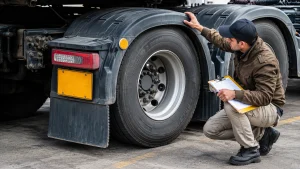
| What your people need to see | Drivers do a pre-trip and mechanics do a PM, and both find defects by looking. Three weeks of road film hides a weeping seal or a chafed line. | Keep the interval short enough that the walk-around is real, and line a wash up ahead of each PM. |
Notice that only the first row is about appearance. The other three are about damage, logistics, and maintenance. A fleet manager who thinks of washing as a cosmetic line item will cut it first when budgets tighten, and then find out in the spring which of the other three rows it was quietly covering.
What to do about it: before you pick a number, write one line per fleet type answering each of the four. Most managers find they have two or three distinct groups in the yard, and that one interval for all of them was never right for any.
3. A starting schedule by fleet type
Here’s a working table. Every row is a starting point drawn from what fleets in Dallas–Fort Worth actually run, not a rule, and every row should bend to your routes, your customers, and your downtime.
| FLEET TYPE | COMMON STARTING INTERVAL | WHY | WHAT TO DO ABOUT IT |
|---|---|---|---|
| Route delivery: beverage, food service, bakery, linen | Weekly | The truck is the brand, parked at customers’ doors all day. Predictable afternoon and overnight downtime makes weekly easy to hit. | Wash on a fixed night. Check the rear door and liftgate area, where hands and product leave the most. |
| Over-the-road tractors | Weekly to every two weeks | Highway film and bugs build fast, and the lamps, reflectors, and door markings an officer sees are on these units. | Wash when units cycle through the yard. If only part of the fleet is home each weekend, rotate so no unit goes past two intervals. |
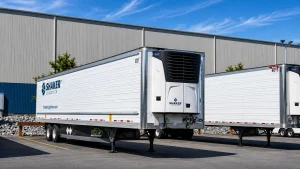
| Dry van and reefer trailers, exterior | Every two to four weeks | Trailers show dirt less from the cab but carry the conspicuity tape and the biggest billboard you own. | Tie trailer exteriors to the tractor schedule where they’re paired. Sides and rear every wash. |
| Refuse and recycling | Weekly, bodies and hoppers more often in summer | Residue smells, draws flies, and holds moisture against steel. Residents and city contract managers notice. | Hot water. Schedule overnight when trucks are in the yard, and don’t let the hopper go a second week in July. |
| Construction and vocational: dump, mixer, lowboy | Every one to two weeks, plus a wash before highway runs after site work | Mud covers door markings and lamps and packs into the frame, where it holds water. | Wash by event as much as by calendar. Mud to the window line doesn’t wait for Saturday. |
| Tankers and hazmat | Weekly to every two weeks | Placards and markings have to be readable, and a clean tank and frame make a leak obvious. | Placard holders and the valve area every wash. |
| Yard spotters, spares, and stored trailers | Monthly, or before returning to service | Nobody sees them and they collect dust more than road film. | Take them off the weekly list. Wash before a unit goes back on the road or to a customer. |
| Any unit after a winter brine event | Within a few days, regardless of schedule | Brine keeps working on steel, wiring, and aluminum as long as it’s there. | Treat it as its own trigger. An undercarriage wash after the roads clear is worth more than the next three scheduled washes. |
Two things in that table save money. The yard-equipment row takes units off the weekly list that never should have been on it. The trailer row stops fleets from washing a trailer four times a month when twice does the job. Getting frequency right is as much about washing the right units less as it is about washing anything more.
FROM THE BAY — THE TRAILERS ALONG THE FENCE
A regional carrier had a weekly wash on forty-odd units, and had for years. When the invoices started listing unit numbers, the operations manager noticed the same six trailer numbers on every one, and walked the yard. All six were spares parked along the back fence, washed every Saturday night and pulled maybe twice a quarter. Meanwhile the eight tractors on the West Texas run were coming back from the oil patch looking two weeks dirty after one. Nobody had been overcharging. The crew washed what was on the yard, exactly as the contract said. The contract was just older than the fleet. The spares moved to monthly and the West Texas tractors went on a midweek wash. The invoice came out within a few dollars of where it started, and the trucks customers actually saw were the ones getting washed.
4. How the seasons move the number in Dallas–Fort Worth
A wash interval that’s right in October is wrong in January and wrong again in June. North Texas has four conditions worth planning around.
Winter: brine
TxDOT pretreats bridges, overpasses, and main lanes with brine before a freeze, and your trucks pick it up before the first sleet falls. It dries to a white film on the lower six feet of the unit and packs into the frame, the wiring, and the wheel ends. Our post on road salt and truck corrosion in DFW covers what it does and how fast. For scheduling, the point is simple: a brine event is a trigger, not a calendar item. Wash within a few days of the roads clearing, undercarriage included.
Spring: pollen and rain
Oak and cedar pollen put a yellow-green film on everything parked outdoors, and spring storms turn road dust into mud spray. Neither does much harm, but both make a white truck look neglected in about four days. Customer-facing fleets that run every two weeks the rest of the year often go weekly from March through May.
Summer: bugs and heat
Lovebugs on the Gulf Coast runs and plain highway bugs everywhere else. In July heat, what hits the bumper and the mirrors bakes on, and every day it sits it takes more work to get off. Left long enough it can mark the finish. Over-the-road tractors are the ones to watch. If drivers are scrubbing their own windshields at fuel stops, the interval is too long.
Fall: the easy season
Dry, mild, and clean. This is when a fleet can stretch an interval without paying for it, and when it makes sense to do the annual look at the schedule before winter.
What to do about it: write the schedule with a base interval and named exceptions. “Every two weeks, weekly March through May, and within three days after any brine event” is a schedule a vendor can run and a successor can understand.
5. Different parts of the truck run on different clocks
“Wash the truck” covers several jobs that don’t need doing at the same frequency. Splitting them is how you stop paying for the wrong one.
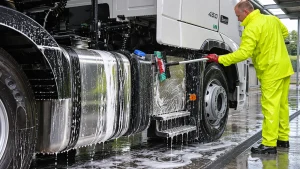
- The exterior you can see. Cab, hood, sleeper, trailer sides and rear. This is the scheduled wash, and it’s what the intervals above describe. Steamaway’s standard is cosmetic cleaning: what you see from ten feet will be clean.
- Lamps, reflectors, tape, and door markings. Part of every exterior wash, and the part that matters at a scale house. If a schedule slips, these are what a driver should wipe on the pre-trip.
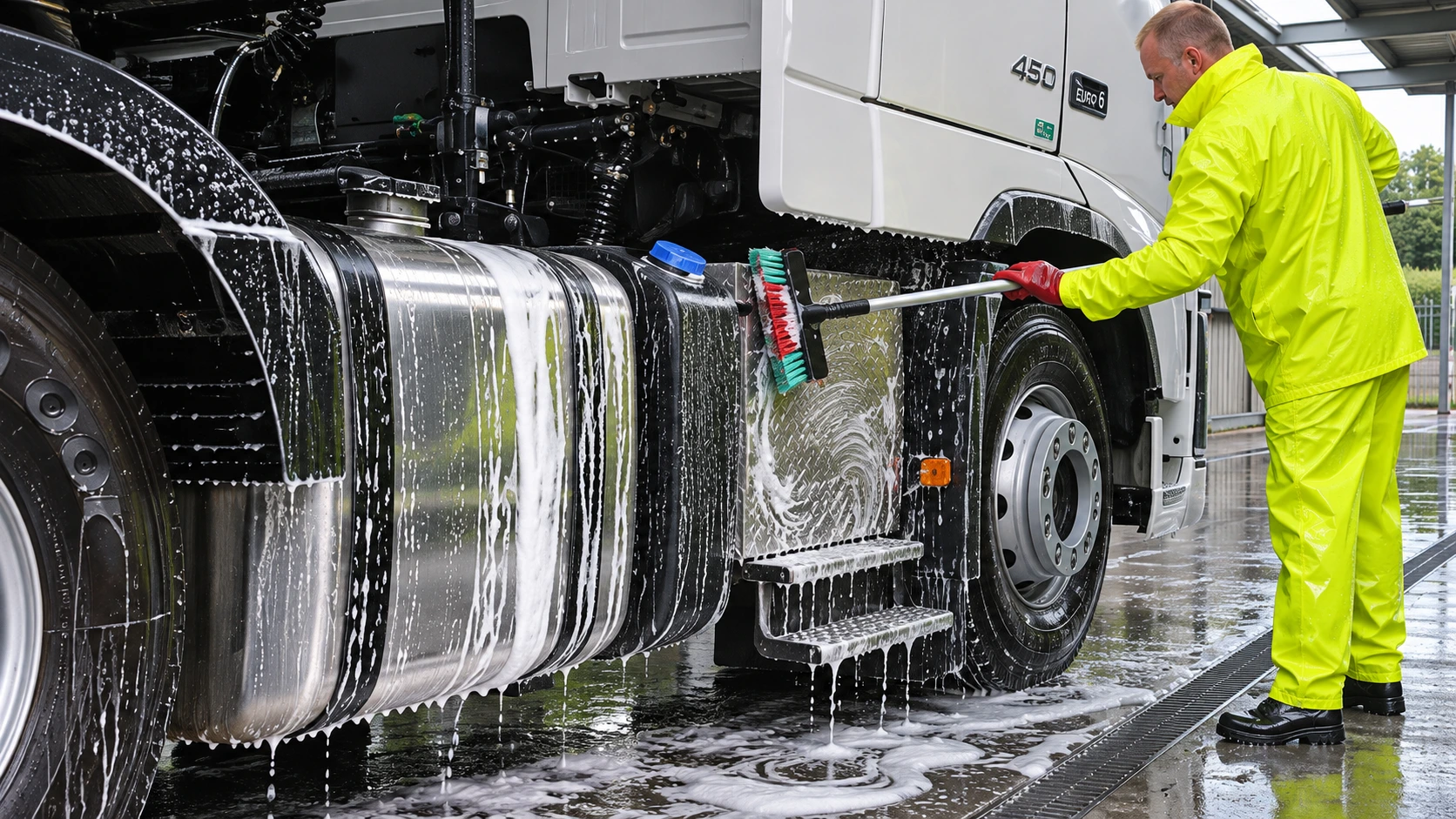
- Frame and undercarriage. Doesn’t need doing every week in dry weather. It does need doing after brine, after mud, and ahead of a PM so the mechanic is looking at steel and not at dirt.
- Trailer interiors. A different service on a different clock. A washout is set by what the trailer hauls and what the shipper requires. See how often a reefer trailer should be washed out.
- Engine compartment, polished aluminum, and detail work. Separate services with separate line items, done occasionally or before a sale or a show. They aren’t part of a weekly fleet wash and shouldn’t be priced as if they were.
The practical upshot: a fleet on a two-week exterior schedule might add an undercarriage wash only in winter and ahead of PMs, and wash out its reefers on the shipper’s schedule, which has nothing to do with either. Three clocks, one yard.
What to do about it: when you ask for a quote, ask for these as separate lines. A single “fleet wash” price that silently includes or excludes the undercarriage is how two bids for the same yard end up far apart.
6. Signs your interval is wrong, in either direction
You don’t need a consultant to tell whether the number is right. The yard tells you.
The interval is too long if:
- You can’t read the USDOT number on a cab door from across the lot.
- The conspicuity tape on your trailers looks grey instead of red and white.
- Drivers are washing their own windshields and mirrors with a squeegee from the fuel island.
- A customer, a city contract manager, or your own sales rep has mentioned it. People rarely say it twice. They just remember.
- Your mechanics hose off the frame themselves before a PM, at shop labor rates.
- DVIRs come back blank week after week on units you know have miles on them.
- There’s still white film behind the wheels two weeks after an ice event.
The interval is too short if:
- The same parked units show up on every invoice.
- The crew is washing trucks that look the way they did when the crew left last week.
- Units are regularly not on the yard on wash night, so the schedule is being hit on paper and missed in practice.
- You’re washing trailer exteriors as often as the route trucks that customers actually see.
Yes, a wash company just told you how to spot overwashing. A schedule that’s too heavy gets cut all at once the first time someone looks hard at the budget, and then the fleet goes from too much to nothing. A schedule that’s right survives the budget meeting.
7. Setting the schedule: a method you can run in an afternoon
Here’s the sequence. It takes an afternoon and a walk around the yard.
- Sort the fleet into groups. Customer-facing, highway, vocational, trailers, and yard or spare. Most fleets have three of the five.
- Answer the four questions for each group. Who sees it, what gets on it, when it sits, and what your people need to see. One line each.
- Map the downtime. For each group, write down when the units are actually parked. This decides the wash night, and sometimes it decides the interval, because a group that’s only all home every other weekend can’t be washed weekly without return trips.
- Pick the longest interval that passes three checks. The truck still looks like your company at a customer’s dock on the last day before the next wash. A driver can do a real pre-trip on it. Nothing damaging has been sitting on it for more than a few days.
- Add the triggers. After a brine event. After site work, before a highway run. The week before a PM. Before a customer audit or a contract renewal visit.
- Put it in writing and put it next to the PM calendar. A wash the week before a PM is worth more than a wash the week after.
- Check it in ninety days, then twice a year. Pull the invoices and look at unit numbers. Which units got washed every time, which got missed, and which didn’t need it.
Step seven is the one that keeps the schedule honest, and it only works if the invoice lists unit numbers. If yours says “fleet wash, 42 units,” you can’t run it. That’s one of the ten checks in our questions to ask any wash vendor.
THE SCHEDULE RULE
The right wash interval is the longest one where the truck still represents your company on the last day, the driver can still see what’s being inspected, and nothing is sitting on the steel long enough to do damage. Shorter than that and you’re paying for washes nobody needed. Longer and you’re paying somewhere else.
8. What frequency costs, and what the gap costs
We’re not going to print a per-unit price in a blog post, because it depends on the equipment, the yard, the count, and what’s in the scope. What we can do is show how the cost behaves, which is more useful for setting a schedule anyway.
Frequency and price per wash move in opposite directions. A truck washed weekly takes less time per wash than one washed monthly, because there’s less on it. A vendor quoting a monthly wash is quoting a harder job. So going from every two weeks to weekly doesn’t double the bill, and going from weekly to monthly doesn’t cut it by three quarters.
Mobilization is a fixed cost. A crew and a rig coming to your yard costs about the same whether they wash twelve units or forty. Schedules that put the whole group on one night cost less per unit than schedules that scatter a few units across several nights.
Units that aren’t there shouldn’t cost anything. If a tractor was out on wash night, it wasn’t washed and it shouldn’t be on the invoice. Steamaway bills only the unit numbers washed. That also means a schedule built around real downtime is the cheapest schedule, because it’s the one where the trucks are actually home.
The gap has costs too, they’re just on other budgets. Mechanics cleaning frames at shop rates. Corrosion on equipment you planned to run ten years. A driver who’d rather work for the carrier down the road with the clean trucks. A customer who reads a dirty truck as a late truck. None of those shows up on a wash invoice, which is exactly why they’re easy to miss.
What to do about it: when you compare a weekly quote to a biweekly one, ask for both, with unit numbers, the same scope, and the same night. The difference is usually smaller than people expect, and it’s the only honest way to see what the shorter interval is buying.
SIGNATURE APPROACH
Steamaway has washed commercial fleets in Dallas–Fort Worth since 1985, and we’d rather build a schedule that survives your budget meeting than sell one that doesn’t. That means sorting the fleet by type before quoting it, washing on your downtime, telling you which units don’t need to be on the weekly list, and putting every unit number on the invoice so you can check the schedule against what actually happened. If a wash isn’t right, tell us before the next scheduled visit and we’ll re-clean it at no charge. Cleaned Right | On Time | Every Time only means something if the schedule was right to begin with.
FROM THE BAY — WEEKLY IN MARCH
A beverage distributor ran a two-week wash for years and it worked. Then one April the sales manager started getting comments from store managers about the trucks, and couldn’t figure out why, since nothing had changed. Nothing had. It was oak pollen season, the trucks were white, and by day five after a wash they were yellow-green from the roofline down. Two weeks was the right interval for nine months of the year and the wrong one for three. The distributor went weekly from March through May and back to two weeks in June. The annual cost moved by a few percent. The comments stopped the first week.
Frequently Asked Questions
How often should fleet trucks be washed?
There’s no single number. How often to wash fleet trucks depends on who sees them, what the road and the load leave on them, when they sit still, and what your drivers and mechanics need to see. Common starting points in Dallas–Fort Worth are weekly for customer-facing route trucks and refuse, weekly to every two weeks for over-the-road tractors, and every two to four weeks for trailer exteriors.
Is there a DOT rule on how often a truck must be washed?
No. Neither the Federal Motor Carrier Safety Regulations nor Texas law sets a wash interval for commercial trucks. The rules require working lamps and reflectors, legible carrier markings, and regular inspection and maintenance. Dirt matters only where it hides those things, which is a reason to wash on a schedule but not a legal frequency.
How often should semi trucks that run over the road be washed?
Weekly to every two weeks is the common range for over-the-road tractors. Highway miles build road film and bugs quickly, and these are the units whose lamps, reflectors, and door markings get seen at scale houses. If only part of the fleet is home each weekend, rotate the schedule so no unit goes more than two intervals between washes.
Do trailers need to be washed as often as tractors?
Usually not on the outside. Every two to four weeks is typical for dry van and reefer exteriors, with the sides and rear done each time so the conspicuity tape stays reflective. Trailer interiors are a separate question: a washout is set by what the trailer hauls and what the shipper’s specification requires, not by the exterior schedule.
Should I wash my trucks more often in winter?
Wash by event more than by calendar. When TxDOT brines the highways ahead of a freeze, the brine dries onto the lower part of the truck and packs into the frame and wiring, and it keeps working as long as it’s there. Wash within a few days of the roads clearing, undercarriage included, whether or not a scheduled wash is due.
Can you wash a truck too often?
You can pay for washes that don’t accomplish anything. Parked spares, yard spotters, and stored trailers don’t need a weekly wash, and trailer exteriors rarely need the same interval as route trucks. If the same parked unit numbers appear on every invoice, the schedule is heavier than the fleet needs, and those units can move to monthly or before return to service.
How do I know if my wash schedule is too infrequent?
Look for the signs in the yard: door markings you can’t read from across the lot, grey conspicuity tape, drivers cleaning their own windshields at fuel stops, mechanics hosing frames before a PM, and blank DVIRs on high-mile units. A comment from a customer is the last sign, not the first.
Does washing weekly cost twice as much as every two weeks?
Generally no. A truck washed weekly has less on it and takes less time per wash, and the cost of bringing a crew and rig to the yard is about the same either way. Ask for both quotes with the same scope, the same night, and unit numbers on the invoice, and compare the actual difference.
Should every truck in the fleet be on the same wash schedule?
No. Most fleets have two or three groups that belong on different clocks: customer-facing units on the shortest interval, highway tractors and trailers in the middle, and yard equipment and spares on the longest. One interval for the whole yard is usually too long for some units and too short for others.
How should a wash schedule line up with preventive maintenance?
Put the two calendars side by side and schedule a wash, frame and undercarriage included, in the week before each PM. A mechanic working on clean steel can see a crack, a seep, or a chafed hose that road film hides. We wash it; your mechanic maintains it, and the first job makes the second one more thorough.
Will Steamaway help set a wash schedule for my fleet?
Yes. We sort the fleet by type, look at when each group is on the yard, and recommend an interval for each, including the units that don’t need to be on the weekly list. Every unit number washed goes on the invoice, so after ninety days you can check the schedule against what actually happened and adjust it. Service covers Fort Worth, Dallas, Arlington, Irving, Grand Prairie, Garland, and Mesquite.
Wash intervals in this article are common starting points drawn from Steamaway’s fleet washing experience in Dallas–Fort Worth since 1985. They are operating practice, not regulatory requirements, and no federal or Texas regulation sets an exterior wash frequency for commercial motor vehicles. References to inspection and maintenance are to 49 CFR Part 393 (parts and accessories), 49 CFR Part 396 (inspection, repair, and maintenance), and 49 CFR §390.21 (marking of commercial motor vehicles). References to winter road treatment describe TxDOT’s publicly reported practice of pretreating North Texas highways with brine ahead of freezing weather. Trailer washout frequency for food loads is governed by the shipper’s written specification under 21 CFR Part 1, Subpart O. Cost behavior is described in general terms; no price is quoted or implied. From the Bay callouts are composites drawn from field experience, with details changed. Steamaway washes equipment; your mechanic maintains it and your driver performs the pre-trip. This article is an operational reference, not legal, regulatory, or maintenance advice.