EQUIPMENT CARE · WINTER BRINE
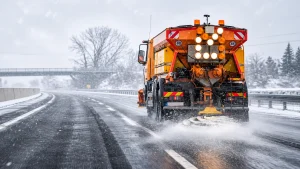
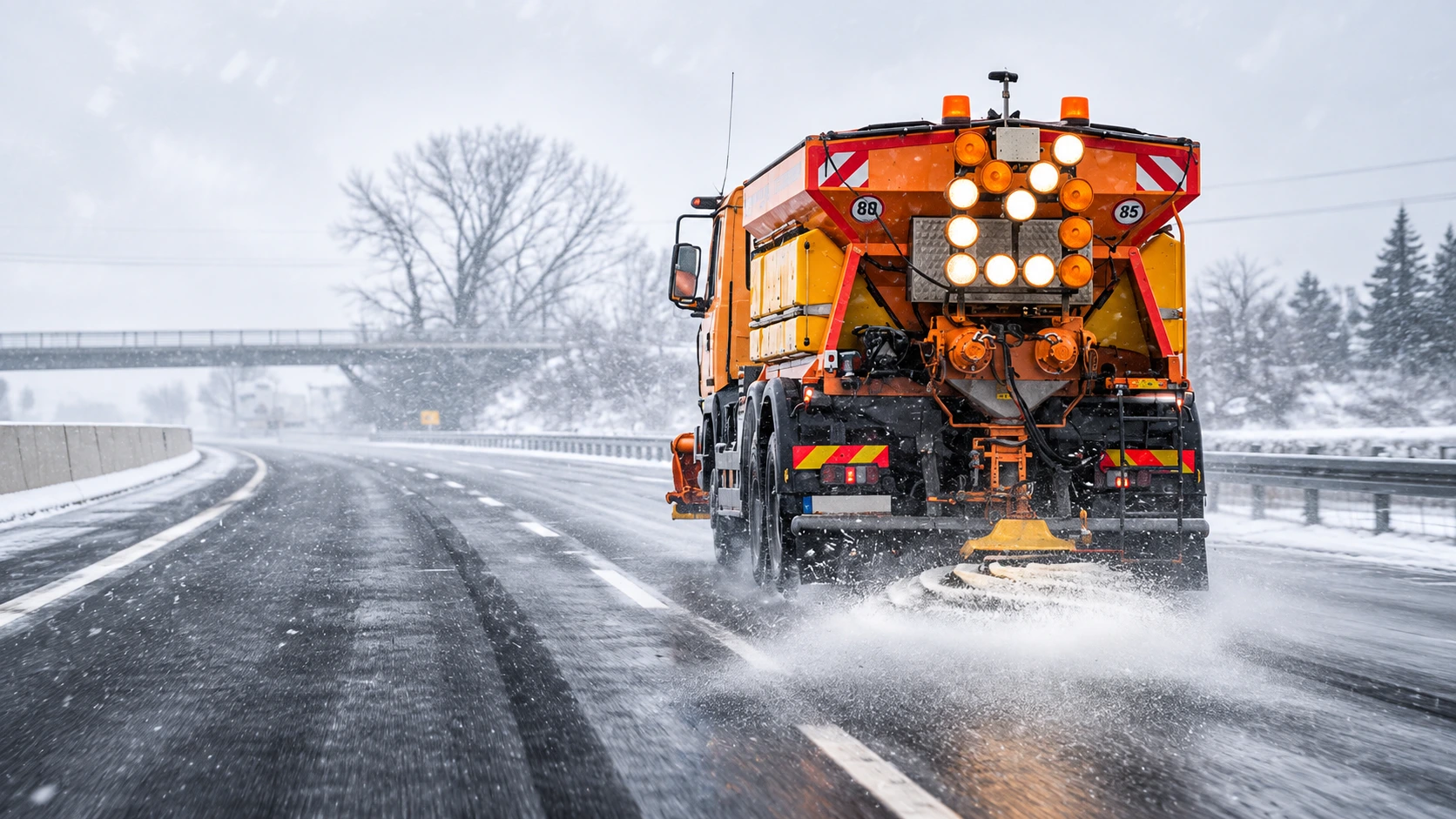
The forecast says freezing rain Thursday night. By Wednesday afternoon TxDOT trucks are already on the overpasses of I-35W, laying down brine. Your tractors run the corridor all day, and by Friday the lower six feet of every unit is wearing a white film that doesn’t rinse off in the rain. Most of your drivers won’t mention it. Your frame rails and wiring harnesses will, about eighteen months from now.
October 28, 2026 · By Steamaway
QUICK ANSWER
Road salt truck corrosion in Dallas–Fort Worth starts with brine, not rock salt. Before freezing weather, TxDOT’s Fort Worth and Dallas Districts pretreat highways, bridges, and overpasses with a salt-and-water brine, and the mix can stay active on the road surface for about a week. Brine is a liquid, so it sprays into frame rails, crossmembers, brake components, and wiring connectors instead of bouncing off the way granular salt does, and it draws moisture back out of the air, which keeps steel wet. Nothing in federal or Texas rules requires a fleet to wash it off. Fleets do it anyway because chloride left on steel through the warm, wet, warm cycle of a North Texas winter is what pushes rust from cosmetic to structural. The practical answer: wash the underside with hot water within a few days of each brine event, keep the regular schedule through winter, and let the clean truck show your mechanic what the salt has already done.
MOBILE FLEET WASHING
Scheduled around your downtime, checked by a supervisor, with every unit number on the invoice and no charge for a truck that wasn’t on the yard.
See Mobile Fleet Washing →
1. What TxDOT actually puts on DFW highways
If you came up in the Midwest you remember rock salt and sand. North Texas doesn’t work that way. The Texas Department of Transportation runs an anti-icing program, which means it treats the road before the ice forms instead of after. The tool is brine: a solution of salt dissolved in water, sprayed from tanker trucks onto the pavement.
TxDOT’s Fort Worth District, which covers Tarrant County and eight surrounding counties, has described the approach plainly. Brine acts like antifreeze. When precipitation lands on a treated surface it dilutes into the brine, the freezing point drops, and the result is slush instead of ice bonded to the roadway. The district has roughly 3,500 miles of main lanes in Tarrant County alone to cover, and it starts with the surfaces that freeze first: bridges and overpasses, which have no ground under them to hold heat.
Two details matter to a fleet manager more than they matter to a commuter.
First, timing. Brine goes down 24 to 48 hours ahead of the weather, during the dry, often mild day before a front. Your trucks are running on it before a single drop falls. If the storm fizzles, the brine still went down.
Second, persistence. TxDOT has said the brine mixture can last about a week on the surface. That’s the operational number. A unit running I-35, I-20, I-30, or 635 the week after a pretreatment is picking up chloride on every trip, in dry conditions, with no rain to dilute it.
Once a storm actually starts, TxDOT shifts from liquid brine to granular products: salt, sand, and salt-based deicers. So a real event gives you both: brine underneath, granular on top.
2. Why brine is harder on a truck than rock salt
Granular salt on a dry road mostly bounces. It hits the tire, flies, and some of it lands on the truck. Brine behaves differently in three ways that matter to steel.
It atomizes. Tires throw liquid brine as a fine spray. The spray carries up into the frame, across the crossmembers, into the fifth wheel, around brake chambers and slack adjusters, and onto every exposed connector on the harness. It reaches places a chunk of rock salt never would.
It creeps. Liquid wicks into seams, lap joints, and the gap between a bracket and the rail it’s bolted to. Those are exactly the places that stay wet longest and get inspected least.
It stays wet. Sodium chloride is hygroscopic: it pulls moisture out of the air. A film of dried brine on a frame rail rehydrates on a humid morning, and North Texas winters produce a lot of humid mornings between fronts. Steel that is wet, salted, and warm corrodes faster than steel that is any one of those things alone. The Federal Highway Administration’s own anti-icing guidance notes that chloride-based liquid deicers are effective precisely because they bond to the pavement and resist being washed away. The same property makes them bond to your truck.
The practical implication: you can’t judge a brine event by what the truck looks like from the cab door. The damage is happening in the places you’d have to lie on the ground to see.
FIELD NOTE — THE CONVECTION OVEN QUESTION
A route fleet brought a three-year-old straight truck through the bay after a February event. Cab and box looked clean enough from ten feet. The crew lifted the rear mud flap and the inside of the rail was white from the rear spring hanger to the crossmember, with a wet, gritty paste packed behind the ABS sensor bracket. Nobody had washed under it since the fall. The paint on the rail was already lifting in a strip you could peel with a thumbnail. Two weeks later the mechanic found the sensor connector green inside. The wash didn’t fix that. It’s what let him find it.
3. Where road salt corrosion lands on the truck
Different parts of a tractor and trailer take brine differently. This is where a wash does the most good, and where your mechanic should be looking after the wash.
| COMPONENT | WHAT BRINE DOES TO IT | WHAT TO DO ABOUT IT |
|---|---|---|
| Frame rails and crossmembers | Spray collects on the inside face and in the web. Coatings lift, surface rust becomes scale, scale becomes section loss over years. | Hot-water undercarriage wash within days of each event. Mechanic checks inside faces at the next PM, not just the outside. |
| Wiring harness and connectors | Brine wicks into connectors and corrodes pins. Shows up as intermittent lights, ABS faults, and sensor codes months later. | Wash clears the film; it does not restore a corroded pin. Flag any green or white on connectors to the shop. |
| Brake chambers, slack adjusters, cam tubes | Salt film on moving parts accelerates wear and seizes adjusters. | Wash, then the shop lubricates per its schedule. A clean adjuster is one the tech can actually see move. |
| Fifth wheel and kingpin area | Brine and grit mix into the grease. Grit in grease is lapping compound. | Wash the plate, regrease per the fleet’s schedule. Don’t wash and skip the regrease. |
| Aluminum: tanks, wheels, trailer siding, air tanks | Chloride pits aluminum and dulls the finish. Pitting is permanent; dulling is cosmetic. | Regular washing prevents pitting from starting. Brightening restores dulled finish but will not fill a pit. |
| Trailer landing gear and rear door hardware | Hinges, rollers, and crank gears take spray directly and get operated by hand. Seize first. | Wash and lubricate. These are the parts a driver notices, so they’re the ones that get reported. |
| Paint and clear coat, lower cab and sleeper | Salt film under a dry wipe scratches; film left on through sun and heat etches. | Wash before anyone wipes it. Never dry-wipe a salted panel. |
| Radiator and charge air cooler fins | Brine spray through the grille dries on the fins and holds grit, restricting airflow. | Low-pressure rinse from the engine side if the fleet’s shop allows it. Not a job for a pressure wand at close range. |
Notice how many rows end with the shop, not the wash. That’s the right scope. We wash it; your mechanic maintains it. A wash doesn’t repair corrosion. What it does is stop feeding it, and it makes the early signs visible to the person whose job is to catch them.
4. The North Texas winter calendar, and why it’s worse than it looks
A fleet manager in Chicago gets four months of salt and knows it. DFW gets something sneakier: a handful of short freezing events scattered between November and early March, with warm, humid days in between.
That pattern is harder on steel than a steady deep freeze, for one reason. Corrosion needs liquid water, and water needs to be above freezing to be liquid. In a hard northern winter the salt sits frozen on the truck and does relatively little until spring. In North Texas a brine event is followed within days by a 65-degree afternoon and a damp morning. The salt rehydrates, the steel is warm, and the chemistry runs. Then another front comes through, TxDOT brines again, and the cycle repeats.
Here’s the practical sequence for a single event, and where a wash fits:
- Pretreatment day. Dry, often mild. TxDOT lays brine on bridges, overpasses, and main lanes 24 to 48 hours out. Your trucks are already picking it up.
- The event. Sleet, freezing rain, or a cold rain that never quite freezes. Granular salt and sand go down on top of the brine. Slush spray coats the undercarriage.
- Days one through three after. Roads dry, the film stays. This is the window. Brine is still active on the pavement and on the truck.
- The warm-up. Humidity rehydrates the film. Steel is wet and salted at 60 degrees. Corrosion is running.
- The next front. Repeat. If the truck wasn’t washed between events, it’s carrying two layers now.
The window that matters is step three. A wash in the three or four days after an event removes the salt before the warm-up turns it back into brine on your frame. A wash three weeks later still helps, but the chemistry has already had its run.
5. How to wash road salt off a truck so it actually comes off
Rinsing a salted truck with cold water from a garden hose moves the salt around. Getting it off takes a few specifics.
Hot water
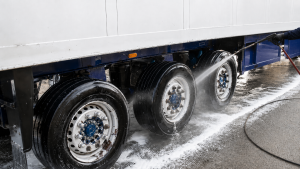
Dried brine and the grit it holds release faster in hot water than cold. Thermal washing has been the core of the Steamaway process since the company started washing trucks in Fort Worth in 1985, and winter is when it earns its keep. Hot water also carries detergent into seams and lap joints where the brine wicked in.
The underside first, and deliberately
Most of the salt is on the lower third of the unit and under it. The crew works the frame rails from both sides, the crossmembers, the inside of the wheels, the suspension, behind the mud flaps, and the fifth wheel plate. Then the exterior. Washing the cab first and the undercarriage as an afterthought leaves the salt where it does the most harm.
Detergent, then a complete rinse
Detergent breaks the film. The rinse carries it off. A detergent left to dry on aluminum or paint is its own problem, so the rinse is the step that gets rushed on a cold night and shouldn’t be. Every product has a label and a safety data sheet that set its dilution, temperature, and dwell; the crew follows them, and so should anyone doing this in-house.
Aluminum needs its own judgment
Polished aluminum tanks and wheels that have gone dull from chloride can be brightened, with either acid-based or non-acid products depending on the surface and the finish. That’s a detailing decision, not a wash decision, and it’s one to make in daylight with the fleet’s input. Brightening restores shine. It does not undo pitting, which is why regular washing through winter is cheaper than brightening in April.
What not to do
- Don’t dry-wipe a salted panel. The grit scratches.
- Don’t blast radiator fins with a close-range wand. Bent fins restrict airflow.
- Don’t wash the fifth wheel and skip the regrease.
- Don’t let wash water run off the yard into a storm drain. More on that in section 7.
6. What a winter wash does, and doesn’t do, at inspection
This is where fleet washing copy usually overreaches, so let’s be exact.
Nothing in 49 CFR Part 393 (parts and accessories necessary for safe operation) or Part 396 (inspection, repair, and maintenance) requires a commercial vehicle to be clean. The regulations require equipment to work and to be inspected. A clean truck does not pass an inspection. A maintained truck passes an inspection.
What a clean truck does is let the maintenance happen. Three specific ways:
The pre-trip. Part 396.11 requires the driver’s vehicle inspection report. A driver walking around a unit with a quarter inch of salted grit on the lower cab, lamps, and reflectors can’t see a cracked lens or a loose conduit. On a clean truck he can.
Lamps and reflectors. Part 393 requires lamps to be operable and reflective devices to reflect. A lens caked with dried brine film is technically operable and practically invisible from fifty feet. Washing is the fix.
The PM. A mechanic working a clean frame can see a hairline crack at a bracket weld, a seep at a fitting, or chafe on a hose. Under a winter’s worth of salt film, those are found later, usually by a roadside inspector or a tow.
So the honest claim is this: clean equipment makes defects visible early, to your own people, before anyone with a badge sees them. It’s an observation about how inspection works. It is not a promise about what an inspector will do with your truck, and anyone who tells you a wash improves your scores is selling something.
SIGNATURE APPROACH
Winter is when a wash schedule either holds or doesn’t. We schedule around the weather and around your dispatch, wash the underside first, record every unit number we wash on your invoice, and don’t bill for a truck that wasn’t on the yard that night. If a wash isn’t right, tell us before the next visit and we’ll re-clean it at no charge, or not charge you for it. Cleaned Right | On Time | Every Time has to mean something on the Tuesday after an ice storm, or it doesn’t mean anything.
7. Where the salt goes after it comes off the truck
Brine washed off a truck is brine on the ground. In most cases, if the wash water stays on your yard, you’re generally fine, at least around here. If it leaves the yard, it has to be recovered and disposed of properly, because wash water running into a storm drain is a non-stormwater discharge under the Clean Water Act’s NPDES program, which TCEQ administers in Texas, and under the stormwater ordinances in Fort Worth, Dallas, and the surrounding cities.
That’s not a reason for alarm. It’s a yard-by-yard question: where does the water go on this lot? A vendor should be able to answer it before the first wash, and a fleet manager should ask. Steamaway’s founder holds the Power Washers of North America environmental wash water certification and has taught wash water recovery to the industry, which is the long way of saying we’ve thought about this question for a while and we handle it where it needs handling.
If you’re washing in-house after a brine event, the same question applies to your own crew. A hose and a pressure washer on a sloped lot next to a curb inlet is the setup that gets a yard a visit from the city.
8. How often to wash a DFW fleet in winter
There’s no regulation that sets this. There’s a defensible practice, and it depends on what the fleet does and where it runs.
| FLEET TYPE | WINTER EXPOSURE | DEFENSIBLE WINTER CADENCE | WHAT TO DO ABOUT IT |
|---|---|---|---|
| Over-the-road / long-haul | Runs the interstates where TxDOT brines first and heaviest. May also pick up salt out of state. | Regular schedule, plus a wash within days of each brine event for units that were in the yard. | Tell the vendor which units ran the corridor during the event; prioritize those. |
| Route fleets: food service, beverage | City arterials, treated less consistently. Many short trips, lots of stopping on slush. | Hold the normal weekly or biweekly schedule; don’t skip the week of the event. | Evening availability makes the post-event wash easier to fit; schedule it before the warm-up. |
| Last-mile and DSP vans | Residential streets, mostly untreated, but high mileage and low ground clearance. | Normal schedule; underside wash after any event with granular salt. | Watch lower door seams and step wells, where slush packs. |
| Refuse | Daily operation regardless of weather. Brine plus whatever’s in the hopper. | Normal schedule holds; the salt is one more thing on an already dirty unit. | Keep the engine compartment and the gap behind the cab clear; that’s a fire question, not a cosmetic one. |
| Construction and vocational | Job sites and FM roads, which TxDOT treats last or not at all. | Lower brine exposure; normal schedule. | Mud holds salt against steel; don’t let packed mud ride for weeks. |
The common thread: the week of a brine event is the wrong week to skip. Most of the fleets that run into spring with rail corrosion didn’t have no wash program. They had one that paused when the weather got bad, which is exactly when it mattered.
FROM THE BAY — THE SCHEDULE THAT HELD
A leasing fleet with units across Irving and Grand Prairie kept a Sunday night mobile schedule through an entire winter, including the two Sunday nights that followed ice events. The crew washed in the cold, undersides first. In March the fleet’s shop ran its spring PMs and the lead tech said the rails looked like October. Nothing clever happened. The schedule just didn’t stop.
What that costs, translated: a wash the week after an event is a line item you can see. A rail that needs section repair in year four, a harness that needs replacing because the connectors went green, a set of polished tanks that pitted past brightening, are line items you’ll see later and larger. We won’t put a number on that difference, because the honest number depends on your equipment and your shop. Your maintenance manager can.
Frequently Asked Questions
Does TxDOT use salt on roads in Dallas–Fort Worth?
Yes. Ahead of freezing weather, TxDOT’s Fort Worth and Dallas Districts pretreat highways, bridges, and overpasses with brine, a salt-and-water solution, and switch to granular salt, sand, and salt-based deicers once precipitation starts. The brine can stay active on the pavement for about a week, so road salt truck corrosion in DFW starts before the storm arrives and continues after it clears.
Is brine worse for trucks than rock salt?
In practical terms, yes. Brine is a liquid, so tires atomize it into a spray that reaches frame rails, connectors, brake components, and seams that granular salt would bounce off. It also wicks into joints and, because salt is hygroscopic, rehydrates on humid days and keeps steel wet. The result is corrosion in places that are hard to see and slow to dry.
How soon after an ice storm should I wash my fleet?
Within a few days. The brine on the truck is still active, and North Texas usually warms up quickly after a front, which rehydrates the salt film and starts the corrosion chemistry on warm, wet steel. A hot-water wash of the undercarriage in that window removes the salt before the warm-up. A wash weeks later still helps, but less.
Does washing a truck prevent rust?
Washing removes the salt and grit that feed corrosion, which slows it substantially; it does not reverse rust that’s already started or repair a corroded part. The second thing a wash does is make early corrosion visible to your mechanic, who can treat or replace the part before it becomes structural. We wash it; your shop maintains it.
Does a clean truck help pass a DOT inspection?
No, not directly. Nothing in 49 CFR Parts 393 or 396 requires a clean truck; the rules require maintained, inspected equipment. What a clean truck does is let your driver see defects on the pre-trip and let your mechanic see them at the PM, and it keeps lamps and reflectors doing their job. Maintained trucks pass inspections. Clean trucks make maintenance easier.
Can road salt damage aluminum on a truck?
Yes. Chloride pits polished aluminum tanks, wheels, and trailer siding and dulls the finish. Dulling can be restored by aluminum brightening. Pitting is permanent; no brightener fills a pit. Regular washing through winter is what keeps pitting from starting, and it costs less than restoration in spring.
Should I wash the underside of the truck or just the outside?
The underside first. Most brine spray lands on the lower third of the unit and under it: frame rails, crossmembers, suspension, inside the wheels, and behind the mud flaps. A wash that covers the cab and skips the undercarriage removes the salt you can see and leaves the salt that matters. Hot water and detergent, then a complete rinse.
Is hot water better than cold for washing road salt off?
Yes. Dried brine and the grit it holds release faster in hot water, and hot water carries detergent into the seams and lap joints where liquid brine wicked in. Cold water from a hose tends to move the salt around rather than remove it, especially on a cold night when it won’t dissolve the film.
Where does the wash water go after washing a salted truck?
If it stays on your yard, you’re generally fine around here. If it leaves the yard and reaches a storm drain, it’s a non-stormwater discharge under the Clean Water Act’s NPDES program, administered by TCEQ in Texas, and under local stormwater ordinances in Fort Worth, Dallas, and surrounding cities, so it has to be recovered and disposed of properly. Ask any wash vendor where the water goes on your lot before the first wash.
How often should a DFW fleet be washed in winter?
No regulation sets a frequency. The defensible practice is to hold your normal schedule through winter and add a wash within a few days of each brine or ice event for units that ran treated roads. The fleets that reach spring with corroded rails usually didn’t lack a wash program; they paused it during the weeks the weather was bad, which is when it mattered.
Will mobile fleet washing work in freezing weather?
Crews wash in cold weather with hot water, undersides first, scheduled around your dispatch and the forecast. The practical limit is the night of the event itself, when the yard is ice. The days immediately after, when the roads are dry and the brine is still on the truck, are exactly when a mobile wash on your yard does the most good.
TxDOT Fort Worth District winter operations as described by district spokesperson Val Lopez in CBS News Texas, “TxDOT crews pretreating North Texas highways ahead of arctic blast,” and NBC DFW, “Texas Department of Transportation Prepares Roads for Possible Winter Weather” and “TxDOT Treating Roads Ahead of Winter Storm”; and Fox 4 News, “TxDOT focusing on pretreating major highways, bridges and overpasses across DFW.” Federal Highway Administration, Manual of Practice for an Effective Anti-icing Program, FHWA-RD-95-202 (1996), on the behavior of chloride-based liquid anti-icers. 49 CFR Part 393, Parts and Accessories Necessary for Safe Operation, and 49 CFR Part 396, Inspection, Repair, and Maintenance, including §396.11, Driver Vehicle Inspection Reports. Clean Water Act §402 (NPDES), 33 U.S.C. §1342, administered in Texas by the Texas Commission on Environmental Quality under the Texas Pollutant Discharge Elimination System; City of Fort Worth and City of Dallas stormwater ordinances. Power Washers of North America environmental wash water certification. Product dilution, temperature, and handling follow each detergent’s label and safety data sheet. From the Bay callouts are composites drawn from field experience, with details changed. Steamaway washes equipment; your mechanic maintains it. This article is an operational reference, not legal, regulatory, or maintenance advice.